
New Supplier
Earlier this year we began sourcing from a second supplier in Bangladesh for our wholesale T-shirt project, a fully unionised factory recommended to us by the Bangladesh Garment and Industrial Workers Federation (BGIWF). Below is a some information on who our newest supplier is and why we have taken this action.
We have also published our latest Transparency Report that provides information on the conditions the garment workers making our clothes operate in and the wages they earn.
Transparency is an important part of tackling exploitation in the garment industry. By providing this information ion the conditions our T-shirts are made in it is evidence that we take our campaign work seriously. We aim to reflect our campaign targets in our clothing range. By ensuring that our garment workers have decent trade union representation we show what ethical fashion really means – ethical fashion means unions!
In this report we also provide an update on how our project works, and the most important aspect, the Garment Workers Solidarity Fund.
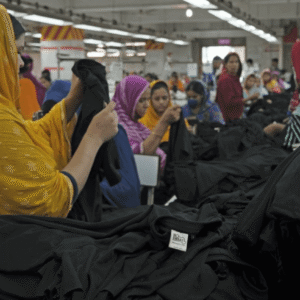
Irene Knitwear
In late 2021 we started searching around for a second supplier for our T-shirt project. Being a campaigning organisation, that for the past 20 years has promoted the importance of trade unions, we wanted to make sure that any workers that make our clothes are unionised.
We contacted a number of trade unions in manufacturing countries such as India, Pakistan and Bangladesh, to ask for recommendations where workers have a strong voice in the running of the factory through their collective bargaining power.
It was the Bangladesh Garment and Industrial Workers Federation that responded with their recommendation of Irene Knitwear and helped us set up our first order.
Trade unions in Bangladesh operate at the factory level, organised by the workers themselves and are registered with the government to make their position official. They then join a union federation like the BGIWF where they get support and guidance.
By working with BGIWF we have been able to ensure that the workers making our clothes have an independent trade union, that has the power to negotiate their pay and conditions. We will continue to work with the BGIWF and lend any support we can to the workers union at Irene Knitwear.
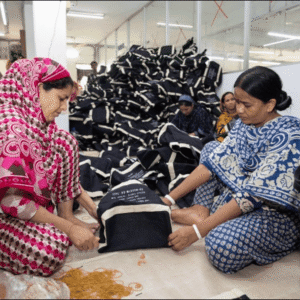
What about Oporajeo?
Over the past year Oporajeo has gone from strength to strength, employing more staff and even buying their own factory. With this growth has come every bigger orders for their primary operation, jute bag production.
In the summer of 2021 at our request the Garment Workers Trade Union Centre carried out a review of the conditions at the factory and provided us with a report, noting the continued positive conditions
Unfortunately ,in November 2021, Oporajeo informed us that they did not have capacity to produce for us at the level they had been as they needed to prioritise their bag production. This meant we had to look for a second supplier to keep up the levels of stock we are now ordering.
We are pleased to see Oporajeo doing so well, and we will always be indebted to them for the support they have given us since we first started this project in 2017.
We will continue to source from them where schedules allow and will keep in touch to support their various social projects in the future. In the meantime we are excited about the future and will be continuing to look for other unionised factories that we can work with as our project grows.

We’ve published our latest Transparency Report that provides all the details on who makes our clothes and how the T-shirts we sell help to fight sweatshop labour.
In this report you will find information on how our clothing line is a not-for-profit company set up to help workers in sweatshops fight for their rights.
We provide information on how that money is generated and where the money we have already raised has been sent.
We give full factory profiles on the places where our clothes are made, that includes the wages the workers earn, but also the trade union representation have have in place.
Workplace democracy is a key part of our project and we actively work alongside trade unions to make sure our workers are having their demands met and we aim to use any economic influence we have, created by our clothing project, to help support workers in their fight for better wages and conditions.
Trade unions in Bangladesh operate differently to those the UK, members do not join an existing union as such, but have to form one in their own workplace and then push for recognition by the government office – a process that is not straight forward due to the influence of factory owners and the attempts at union busting. Once a factory union is registered with the government, they can then choose to join with a larger trade union federation.